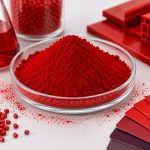
Visible light absorbing pigment
What is Visible Light Absorbing Pigment?
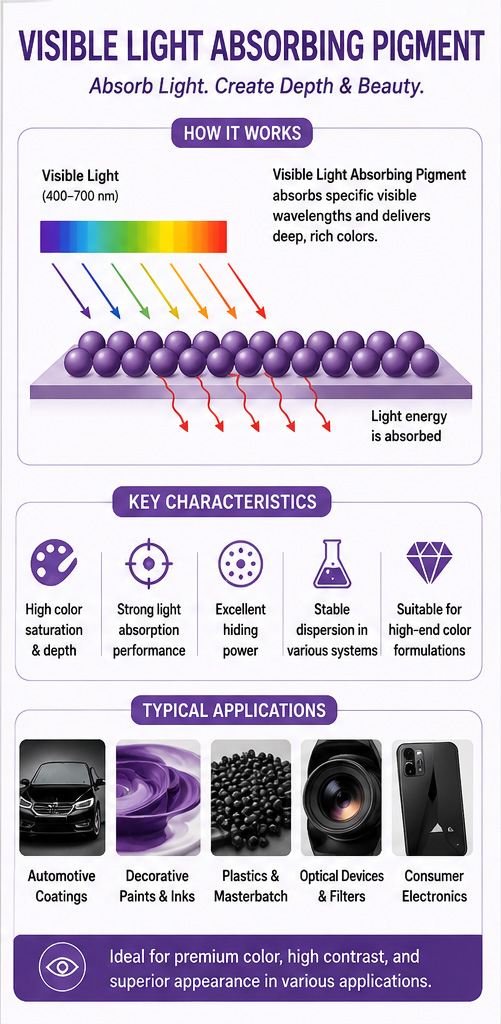
Visible light absorbing pigment is a type of functional pigment designed to absorb specific wavelengths within the visible spectrum (400–700 nm). It is primarily used to achieve deep color effects, high optical density, and enhanced visual contrast.
Unlike reflective or cutoff pigments, its main function is aesthetic and optical control rather than thermal regulation.
How It Works
These pigments absorb selected visible wavelengths and convert light energy into heat or dissipate it internally. This results in rich, saturated colors and improved light-shielding performance.
Main Characteristics
High color saturation and depth
Strong light absorption performance
Excellent hiding power
Stable dispersion in various resin systems
Suitable for high-end color formulations
Prijave
Visible light absorbing pigments are widely used in:
Automotive coatings (deep black, metallic tones)
Decorative paints and inks
Plastics and masterbatch coloring
Optical devices and filters
Consumer electronics housings
Why It Matters
Visible light absorbing pigments are essential for industries requiring premium visual appearance, high contrast, and consistent color performance under different lighting conditions.
Frequently Asked Questions
Q1: What is visible light absorbing pigment used for?
It is used to absorb visible light wavelengths to create deep, rich colors and improve optical density in coatings and plastics.
Q2: What kind of colors can be achieved with these pigments?
They are commonly used for deep blacks, high-saturation colors, and premium decorative finishes.
Q3: Is visible light absorbing pigment the same as infrared pigment?
No. Visible light absorbing pigments focus on the visible spectrum, while infrared pigments focus on heat-related infrared radiation.
Q4: What industries use visible light absorbing pigments?
They are widely used in automotive coatings, electronics housings, inks, plastics, and decorative paints.
Q5: Does it improve hiding power in coatings?
Yes, it provides strong opacity and excellent covering ability, making it suitable for high-end surface finishes.
👉 Contact us to discuss your application requirements.
Povezani proizvodi
 Infrared transmitting pigment
- Infrared reflective pigment
- Infrared cutoff pigment
- What Is Pigment Red 177? Properties, Applications, and Benefits Explained
- Pigment Red 146: Properties, Applications, and Technical Guide
- Pigment Red 177 Technical Data: Heat Resistance, Light Fastness, and Chemical Stability
 Pigment narančasto 64-Corimax Orange GP
- Pigment Red 177 for Industrial Coatings: Why It Is the Preferred High-Performance Red Pigment
- Pigment black 32
- Pigment crvena 208-Corimax crvena HF2B